Chat Local vs. Bridgefy
Bridgefy pioneered consumer mesh messaging and remains the most downloaded app in the category. Here is how Chat Local differs — including the places where Bridgefy is the better choice.
Credit where it's due
Bridgefy made Bluetooth mesh messaging mainstream. It has been used during protests, hurricanes, and festivals worldwide, supports both iOS and Android, and offers an SDK other apps build on. If you need cross-platform offline messaging today, Bridgefy is a legitimate choice. This page lays out where the two apps genuinely differ so you can pick the right one — claims verified August 2026; check Bridgefy's current listing for anything newer.
The architectural differences
- Account & activation: Bridgefy requires internet for initial activation. Chat Local requires no account, no email, no phone number, and no internet — ever. If you first open it on the playa or mid-trail, it still works.
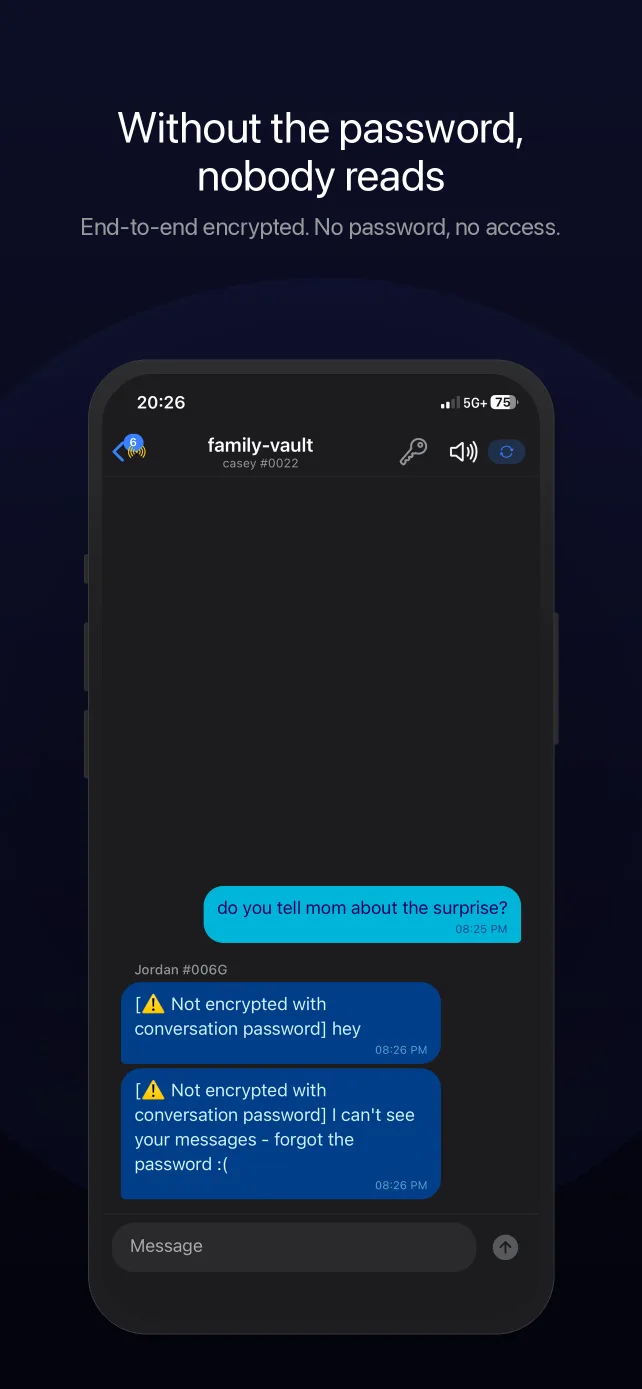
- Encryption posture: Chat Local encrypts every message with AES-256-GCM by default and offers password-protected end-to-end encryption (Pro) where relay devices can't read what they forward. Bridgefy's original protocol had publicly documented vulnerabilities in 2020; it has since adopted the Signal protocol — a genuine improvement.
- Discovery: Chat Local shows you conversations happening nearby with a message preview before you join — like a scanner for local chats. Bridgefy connects you with contacts but has no equivalent of browsing nearby public conversations.
- Platforms: Bridgefy runs on iOS and Android. Chat Local is currently iPhone-only (iOS 15+) for now — Android is on the roadmap. For mixed groups this can be the deciding factor today, and that's fine.
- Servers: Chat Local has none. Messages exist only on participating devices, so there is no infrastructure to subpoena, breach, or shut down.
Quick comparison
| Feature | Chat Local | Bridgefy |
|---|---|---|
| Platforms | iPhone (iOS 15+) | iOS & Android |
| Internet needed to activate | Never | Yes, once |
| Account required | No | Sign-up required |
| Default message encryption | AES-256-GCM, all messages | Signal protocol (since late 2020) |
| Password-protected E2EE rooms | Yes (Pro) | No |
| Nearby conversation discovery | Yes, with preview | No |
| Servers involved | None | Account/activation infrastructure |
| Price | Free + optional Pro | Free + premium |
Verified August 2026. Bridgefy ships updates regularly — check their current App Store listing. Spotted an error? Email [email protected] and we'll fix it.
What Chat Local costs
Chat Local is free to download and use: Bluetooth mesh messaging (50-character messages), default AES-256-GCM encryption, delivery confirmations, 2 conversations, and a 20-message history cost nothing. Pro — $4.99/month or $29.99/year, or $59.99 once for lifetime access — adds unlimited conversations, 400-character messages, password-protected end-to-end encryption, message search, chat export, themes and backgrounds, and faster sending.
Frequently Asked Questions
Is Chat Local better than Bridgefy?
They make different trade-offs. Bridgefy supports both iOS and Android and is the most widely downloaded mesh messenger. Chat Local is iPhone-only for now (Android is on the roadmap) but encrypts every message by default, never requires an account or internet activation, and adds nearby conversation discovery with message previews. If everyone in your group has an iPhone, Chat Local offers more privacy with less setup; for mixed iPhone/Android groups, Bridgefy or bitchat fit better.
Does Bridgefy require the internet?
Bridgefy requires an internet connection for initial activation, then works offline over Bluetooth mesh. Chat Local never requires the internet — download it, pick a display name, and it works, even if you first open it somewhere with no service.
Was Bridgefy's encryption really broken?
In August 2020, university researchers published serious vulnerabilities in Bridgefy's original protocol, showing messages could be read and impersonated. To Bridgefy's credit, it responded by adopting the Signal protocol later in 2020. Chat Local took a different path: AES-256-GCM encryption on every message from day one, plus optional password-protected end-to-end encryption (Pro) where only people with the password can decrypt — even devices relaying the message cannot read it.
Can Chat Local and Bridgefy message each other?
No. Mesh messaging apps use incompatible protocols, so everyone in your group needs the same app. Decide before you go off-grid and have everyone install it while you still have signal.
Which is better for festivals, Chat Local or Bridgefy?
Both work at festivals. Chat Local was built around the festival use case: nearby conversation discovery (find your camp's chat without typing anything), default encryption in crowds, and no account to set up at the gate. See our festival guide for the full setup checklist.
Does it work with my phone locked or in my pocket?
Yes. Chat Local keeps looking for nearby devices and reconnecting to them while the app is backgrounded and the screen is off, so messages keep arriving with the phone pocketed. Keep Bluetooth enabled and don't force-quit the app; background delivery can be slightly less immediate than with the app open on screen.
How do I know whether my message actually got through?
Every message you send reports its real status underneath it: sending, sent, or received by the number of nearby devices that confirmed it — including devices reached by mesh relay. If nobody was in range, it says the message wasn't delivered instead of showing a false success.
Should I send sensitive information over Chat Local?
Use the right tier. Chat Local has two levels of encryption: default encryption (AES-256-GCM with keys built into the app) protects every message from passive radio eavesdropping, but like any built-in scheme it should be treated as strong obfuscation rather than secrecy — assume a determined attacker with the app could read default-tier messages. For anything sensitive, use a password-protected conversation (Pro): the key is derived from your password, only people who know it can read the messages — even relaying phones can't — and the app marks each message that was actually sent encrypted with a lock icon. Also know what is visible regardless: conversation names and sender display names are broadcast to nearby app users by design (that's how nearby discovery works), and Bluetooth transmissions are detectable as radio activity. Name conversations accordingly.
Set It Up Before You Need It
Chat Local is free on the App Store. Download it while you still have signal.